Fluffy homemade pancakes
Tall, tender pancakes from pantry staples: a thick batter, a gentle fold and a medium-hot griddle. Makes 8 to 10, with swaps and freezing tips.
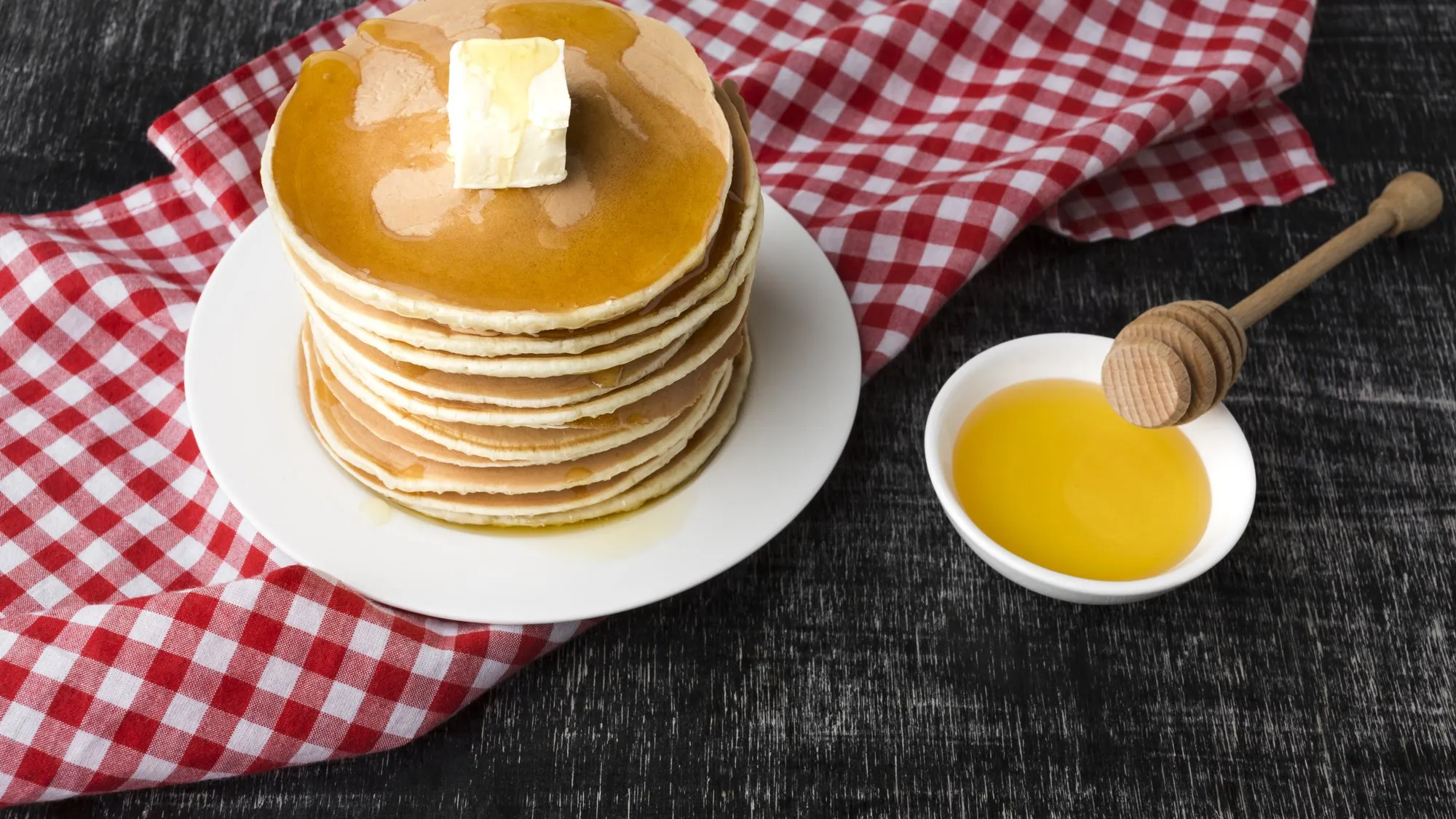
Pancakes are one of the simplest things you can make from the pantry: flour, milk, an egg, a little sugar and baking powder. This recipe makes 8 to 10 tall, tender pancakes with golden edges and soft centers, and it uses plain milk, so there’s no need to buy buttermilk.
Key takeaways
- Baking powder makes the lift, so use a fresh tin and measure it exactly.
- Stir the batter just until the flour disappears. A few lumps are what you want.
- Cook over steady medium heat (375°F on an electric griddle) and flip once, when bubbles cover the surface and the edges are set.
- Cooled pancakes freeze well and reheat in a toaster or microwave.
Why this recipe works
The batter follows the standard formula for American pancakes: about 1 1/2 cups of flour to 1 1/4 cups of milk, with one egg, a few tablespoons of melted butter and between 2 and 3 1/2 teaspoons of baking powder, depending on the recipe. This version uses 2 1/2 teaspoons, enough for a good rise without the slightly metallic taste that too much baking powder can leave.
Mixing the wet and dry ingredients separately, then combining them gently, keeps the batter from developing too much gluten. That is the difference between a pancake that is light and one that is rubbery. Resting the batter for 5 minutes lets the flour absorb the liquid, which thickens it slightly and helps the pancakes puff.
Ingredient notes
Flour. Plain all-purpose flour works best. Spoon it into the measuring cup and level it off, or weigh it (190 g). Scooping straight from the bag packs in extra flour and gives dense pancakes.
Baking powder. Check that it is still active by stirring a teaspoon into hot water. If it fizzes, it is good. Old baking powder is the most common reason pancakes turn out flat.
Milk. Whole milk gives the richest result, but any milk works. Cold milk can make the melted butter clump, so let the butter cool slightly and whisk it in quickly.
Butter. Melted butter adds flavor and keeps the pancakes tender. Neutral oil works in a pinch.
Sugar. Two tablespoons add a little sweetness and help the pancakes brown evenly.
Tips for fluffy pancakes
- Fold, don’t whisk. Stir with a spatula until you no longer see dry flour, then stop. Small lumps will cook out.
- Preheat fully. A griddle that is too cool makes pale, flat pancakes. One that is too hot browns the outside before the center is cooked. A drop of water should sizzle and evaporate quickly.
- Use a measuring scoop. A 1/4-cup scoop gives pancakes of the same size, 8 to 10 from this batter, so they cook at the same pace.
- Don’t press them down. Pressing squeezes out the air that gives pancakes their height.
- Flip once. The first side needs 2 to 3 minutes. The second side cooks faster.
- Grease lightly. Wipe away any excess so the pancakes brown evenly instead of frying.
- Keep them warm in the oven. Spread the pancakes on a baking sheet in a 200°F oven so they stay warm without steaming and going soft.
Don’t taste the raw batter. Raw flour and raw egg can both carry germs, and the CDC advises against eating unbaked batter or dough, including pancake batter. Wash your hands and bowls after handling it.
Variations and substitutions
Buttermilk pancakes. Swap the milk for 1 1/4 cups of buttermilk and use 1 teaspoon of baking powder plus 1/2 teaspoon of baking soda instead of the 2 1/2 teaspoons of baking powder. The batter will be slightly thicker, and the pancakes a little tangy.
Buttermilk without buttermilk. Stir 1 tablespoon of lemon juice or white vinegar into 1 cup of milk, then add enough milk to reach 1 1/4 cups. Let it sit for 5 minutes and use it in place of the milk, keeping the baking powder as written.
Blueberry or chocolate chip. Use about 1/2 cup of berries or chips in total, scattering a few on each pancake right after pouring the batter, rather than stirring them in. They stay in place and don’t tint the batter.
Less sugar. Leave out the sugar entirely. The pancakes will taste plainer and brown more slowly.
No egg. Replace the egg with 1 tablespoon of ground flaxseed stirred into 3 tablespoons of water and left for 5 minutes to thicken. The pancakes will be more delicate, so make them smaller and wait for set edges before flipping. See our guide to egg substitutes for baking for more options.
Whole wheat. Replace up to half of the flour with whole wheat flour, and add a tablespoon or two of extra milk if the batter seems thick.
Storing, freezing and reheating
Refrigerator. Let the pancakes cool, then refrigerate them within 2 hours of cooking in a covered container or sealed bag. USDA guidance for leftovers is 3 to 4 days in the refrigerator.
Freezer. Freeze cooled pancakes in a single layer on a tray until firm, then stack them with parchment paper between and seal them in a freezer bag. They keep well for up to 2 months.
Reheating. You can reheat pancakes straight from the freezer. Toast them for a crisp edge, or microwave a small stack under a damp paper towel, checking after 20 seconds. For a larger batch, cover the pancakes with foil and warm them in a 300°F oven until hot. Reheat leftovers until they are steaming hot, to 165°F.
Making ahead. Mix the dry ingredients the night before and keep them in a covered bowl. Whisk in the wet ingredients in the morning. Pancake batter is best cooked soon after mixing, because baking powder starts working as soon as it meets liquid.
Frequently asked questions
How do you make pancakes fluffy?
Use fresh baking powder, measure the flour carefully, mix the batter only until combined and cook over steady medium heat. A thick batter and a short rest also help.
Why are my pancakes flat?
The usual causes are old baking powder, an overmixed batter or a batter that was too thin. Check the baking powder, stir less and add a spoonful of flour if the batter runs freely off the spoon.
Why are my pancakes rubbery?
Overmixing develops the gluten in the flour. Stir just until the dry ingredients are moistened and leave small lumps in the batter.
When should I flip a pancake?
When bubbles have formed across the top, a few have popped and the edges look dry and set, usually after 2 to 3 minutes.
Can I make pancake batter ahead of time?
It is best used within a few minutes of mixing. For a faster morning, combine the dry ingredients ahead and add the wet ones just before cooking.
Can I use water instead of milk?
You can, but the pancakes will be less rich and tender. Milk adds fat and flavor that water can’t.
Can I make the pancakes without sugar?
Yes. Leave it out and keep everything else the same. They will taste less sweet and brown more slowly.
Recipe
Fluffy homemade pancakes
- Prep
- 10 min
- Cook
- 15 min
- Total
- 25 min
- Makes
- 8 to 10 pancakes (4 servings)
Ingredients
Dry ingredients
- 1 1/2 cups (190 g) all-purpose flour
- 2 tablespoons granulated sugar
- 2 1/2 teaspoons baking powder
- 1/2 teaspoon fine salt
Wet ingredients
- 1 1/4 cups (300 ml) milk
- 1 large egg
- 3 tablespoons (43 g) unsalted butter, melted and cooled slightly
- 1 teaspoon vanilla extract
For cooking
- Butter or neutral oil, for the griddle
Method
- 1 Whisk the flour, sugar, baking powder and salt together in a medium bowl.
- 2 In a second bowl, whisk the milk, egg, melted butter and vanilla until combined.
- 3 Pour the wet ingredients into the dry ingredients. Stir gently with a spatula just until the flour is moistened. The batter should be thick and lumpy, with a few small lumps left. Let it rest for 5 minutes while the pan heats.
- 4 Heat a griddle to 375°F (190°C), or set a large heavy skillet over medium heat. Brush lightly with butter or oil.
- 5 Pour or scoop about 1/4 cup of batter per pancake onto the hot surface, leaving room for spreading. Cook for 2 to 3 minutes, until bubbles form across the top, some of them pop and the edges look set.
- 6 Flip once and cook for 1 to 2 minutes more, until the second side is golden and the center springs back when pressed lightly. Lower the heat if the outsides brown before the middle is cooked.
- 7 Serve right away, or keep the finished pancakes in a single layer on a baking sheet in a 200°F (95°C) oven while you cook the rest.
Notes
- Cook one test pancake first. If it browns too fast, lower the heat.
- Stir the batter as little as possible. Overmixing makes pancakes chewy instead of tender.
- Refrigerate cooled leftovers within 2 hours in a covered container. They keep 3 to 4 days. Reheat until steaming hot, to 165°F.
- Freeze cooled pancakes in a single layer, then stack them with parchment between and keep in a freezer bag for up to 2 months for best quality.