How long to boil chicken breast (fresh, frozen and for shredding)
Boneless chicken breasts take about 12 to 20 minutes at a gentle simmer, bone-in 30 to 45. Times for fresh and frozen, plus how to shred and store it.
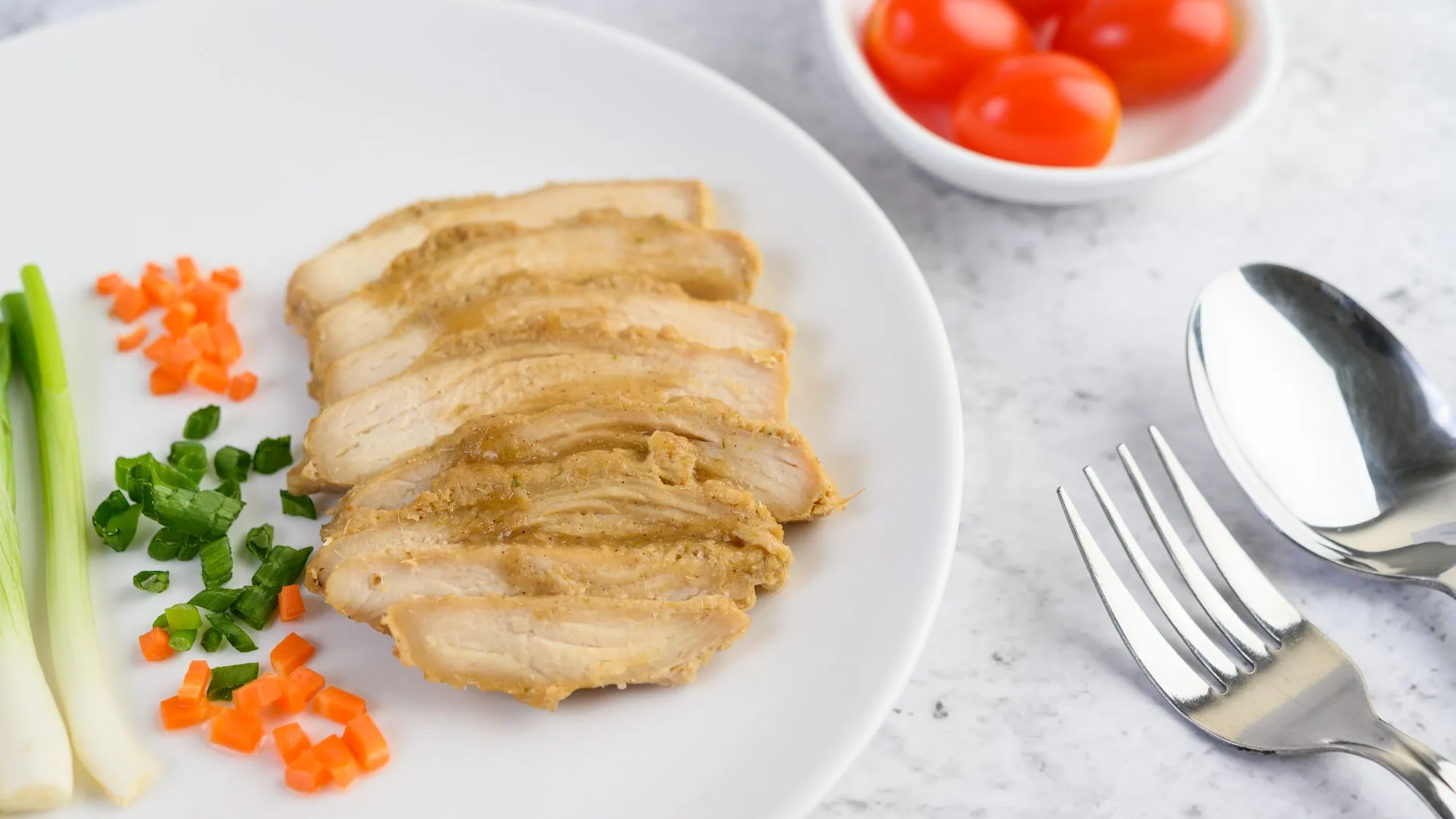
Boneless, skinless chicken breasts take about 12 to 20 minutes at a gentle simmer, and bone-in breasts take 30 to 45. The time is only a guide: the chicken is done when a food thermometer in the thickest part reads 165°F.
Keep the water at a bare simmer, not a rolling boil, and the meat stays tender enough to slice or shred. The temperature and storage rules below come from the USDA Food Safety and Inspection Service (FSIS).
Key takeaways
- Boneless, skinless breasts need about 12 to 20 minutes at a gentle simmer. Bone-in breasts need 30 to 45.
- Frozen breasts can go straight into the pot, but allow about 50% more time.
- Poultry is safe at 165°F, measured in the thickest part. Color alone is not a reliable sign.
- Rest the chicken for about 5 minutes in the hot liquid, then slice or shred.
- Refrigerate cooked chicken within 2 hours and use it within 3 to 4 days.
How long to boil chicken breast
The times below start once the water has come back to a gentle simmer after the chicken goes in. They assume the breasts are fully covered with water and cooked in a single layer.
| Type of breast | Typical size | Time at a gentle simmer | Notes |
|---|---|---|---|
| Boneless, skinless, thin or halved | Under 6 oz (170 g) | 8 to 12 minutes | Slice thick breasts in half horizontally to speed things up |
| Boneless, skinless, fresh | 6 to 10 oz (170 to 285 g) | 12 to 20 minutes | Start checking at 12 minutes; large, thick breasts need the full 20 |
| Bone-in, skin-on or skinless, fresh | 12 to 16 oz (340 to 450 g) | 30 to 45 minutes | The bone slows the heat; test away from the bone |
| Boneless, frozen | 6 to 10 oz (170 to 285 g) | 20 to 30 minutes | About 50% longer than fresh |
| Bone-in, frozen | 12 to 16 oz (340 to 450 g) | 45 to 60 minutes | Check often and add time as needed |
These ranges are our estimates for a gentle simmer. FSIS’s approximate chart lists longer times (25 to 30 minutes for a 4-ounce boneless breast half, 35 to 45 for a 6- to 8-ounce bone-in half). Times vary with thickness and heat, so the thermometer decides.
Why a gentle simmer works better than a hard boil
A rolling boil cooks the outside of the chicken much faster than the center. The outer meat can turn dry and stringy while the middle is still catching up. A gentle simmer, with small bubbles rising steadily to the surface, heats the breast more evenly.
Start with enough water to cover the chicken by about an inch. Bring it to a boil, add the chicken, then lower the heat as soon as the water returns to a boil. A lid helps hold the temperature steady. If you’re cooking several breasts, pick pieces that are close in size so they finish together.
How to boil chicken breast step by step
For two boneless, skinless breasts of about 6 to 8 ounces each, you need:
- 4 cups (about 1 liter) water, or enough to cover the chicken by an inch
- 1 teaspoon kosher salt
- Optional aromatics: 1 bay leaf, 2 crushed garlic cloves, a few peppercorns, or an onion wedge
- Put the water, salt and any aromatics in a saucepan and bring to a boil.
- Add the chicken in a single layer. When the water returns to a boil, reduce the heat to low so it just simmers, and cover.
- Cook for 12 minutes, then check the thickest part with a food thermometer. If it’s below 165°F, keep simmering and check again every 2 to 3 minutes.
- Turn off the heat once every piece reads 165°F. Let the chicken rest in the hot liquid for about 5 minutes.
- Lift it out and slice, dice or shred.
Salt and aromatics season the meat from the outside in. If you plan to use the chicken in several different dishes, keep the seasoning light. Swapping some or all of the water for broth gives more flavor, but cut back on the added salt.
How to check that it’s done
Poultry is safe to eat at 165°F, whether it’s breasts, legs, thighs, wings or ground chicken. FSIS says the only reliable way to know is a food thermometer, because color does not tell you. Safely cooked chicken can still look slightly pink, and it can look done before it is.
- Slide the thermometer in from the side so the tip reaches the center of the thickest part of the breast.
- Keep the tip away from bone and from the bottom or sides of the pot, both of which give false readings.
- Check every breast, since sizes vary.
- If one is under 165°F, put it back in the simmering water and test again in a few minutes.
How to boil chicken breast for shredding
Chicken for shredding needs no extra cooking. Simmer it until it reaches 165°F, rest it, and the meat pulls apart easily.
- Rest the cooked breasts in the warm liquid for about 5 minutes. This helps them stay moist.
- Move them to a cutting board or large bowl.
- Pull the meat apart with two forks, working with the grain. For a big batch, a hand mixer on low speed shreds it in seconds; stop as soon as the texture looks right.
- If the shreds seem dry, stir in a spoonful or two of the warm cooking liquid, a little at a time.
Fine shreds mix evenly into chicken salad and sandwich fillings. Larger pieces hold their shape in soups, tacos and casseroles. Shredded chicken also pairs well with a pot of stovetop rice.
Can you boil chicken breast from frozen?
Yes. FSIS says chicken can be cooked from the frozen state on the stove or in the oven, and the cooking time may be about 50% longer. Do not cook frozen chicken in a slow cooker or the microwave: thaw it first for those methods.
To simmer frozen breasts, put them in the pot, cover with cold water and bring it up to a gentle simmer. Breasts that are frozen together in a block need to separate as they soften, so nudge them apart with tongs once the outside thaws. The outside can look done while the center is still raw, so check every piece with a thermometer.
If you’d rather thaw first, FSIS recommends three safe ways: in the refrigerator, in cold water (changing the water every 30 minutes) or in the microwave. Never thaw chicken on the counter. A pound of boneless breasts thaws in an hour or less in cold water, and chicken thawed that way or in the microwave should be cooked straight away.
Don’t rinse the chicken first
FSIS does not recommend washing raw chicken before cooking. Rinsing spreads bacteria from the raw meat and its juices to the sink, counters and other foods, and it doesn’t remove bacteria from the chicken. Only cooking does that. Wash your hands, the cutting board and any utensils with soap and hot water after handling raw chicken.
What to do with the cooking liquid
The water left in the pot is a light, lightly seasoned broth. Strain it and use it in soup, rice or sauces, or cool it and refrigerate it. FSIS lists chicken broth and gravy as keeping 3 to 4 days in the refrigerator, and when you reheat sauces, soups and gravies it says to bring them to a rolling boil.
How to store boiled chicken
- Cool it quickly. Refrigerate cooked chicken within 2 hours of cooking (1 hour if the room is above 90°F). Slice or shred it and spread it in shallow, covered containers so it cools fast.
- Fridge. Keep it at 40°F or below and use it within 3 to 4 days.
- Freezer. FSIS lists leftover cooked chicken at 4 months for best quality, and food kept continuously at 0°F is safe indefinitely. Portion it, press out the air and label the date.
- Reheat. Heat leftovers to 165°F, and cover them so they hold moisture.
Moisture helps chicken freeze well. A splash of cooking liquid in the freezer bag keeps shredded chicken from drying out. FSIS gives a longer freezer time for chicken covered in broth or gravy (6 months for best quality) than for plain cooked pieces.
Frequently asked questions
How long should I boil two chicken breasts?
Two average boneless, skinless breasts take about 12 to 20 minutes once the water returns to a simmer. The number of breasts matters less than their thickness and whether they sit in a single layer, fully covered.
Is 20 minutes long enough to boil chicken breast?
For most boneless breasts, yes, and for thin ones it may be more than enough. A large, thick breast or a bone-in breast can need longer. Check the thickest part with a thermometer for 165°F instead of relying on the timer.
Should I boil chicken breast covered or uncovered?
Either works. Covering the pot holds the heat at a steady simmer and shortens the time to bring it back up, so many cooks use a lid. Just keep the water at a gentle simmer, not a hard boil.
Can you overcook boiled chicken?
Yes. Chicken that sits in simmering water well past 165°F turns dry and tough. Take it off the heat as soon as the thickest part reaches 165°F, and rest it in the warm liquid for only a few minutes.
Do I need to cook chicken longer to shred it?
No. Once it has reached 165°F, rest it and shred. Cooking longer only dries it out.
Is it safe to boil chicken breast from frozen?
Yes. FSIS says it is safe to cook chicken from frozen on the stove or in the oven, as long as it reaches 165°F. Expect the time to be about 50% longer than for fresh chicken.
How long does boiled chicken last in the fridge?
3 to 4 days, as long as you refrigerated it within 2 hours of cooking. After that, freeze it, or throw it out.